


Notpla receives EU funding to develop plastic-free coffee cups
Key takeaways
- Notpla has been granted €4 million (US$4.66 million) in Horizon Europe funding with 14 European partners to develop fully natural, home compostable coffee cups without plastic coatings.
- The project’s first phase focuses on material testing and production scale-up.
- Notpla is advancing commercialization through real-world trials and deployments.
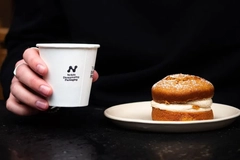
Notpla, together with 14 European partners, has secured €4 million (US$4.66 million) in Horizon Europe funding to advance its plastic-free coffee cup range. The project aims to develop fully natural, home compostable disposable cups with no plastic coatings at scale.
Notpla has developed a viable alternative to plastic-lined cups, meeting the demands of modern foodservice with natural materials. The first phase of the project focuses on developing a full coffee cup range, evaluating natural materials, and scaling solutions designed for circularity.
“Our next step sees Notpla bring together a consortium of 14 great partners across the entire value chain; from biomass and agricultural waste to scalable production, to end-of-life testing and full lifecycle assessment,” says the company.
Scaling innovation
Project partners include Ceamsa, TomaPaint, and Walki Group, alongside academic and research institutions from the EU and UK.
Notpla trialed its new espresso cup with The Earthshot Prize in Rio de Janeiro, Brazil, last year. The company also piloted the Gen 1 espresso cup, which is designed to be free of microplastics.
Meanwhile, Notpla succeeded in developing a plastic-free and home-compostable drinks carrier. The company provided the solution to Allianz Stadium in London, UK, making it the first in the country to adopt such a drinks carrier.
Last week, Notpla began to supply Imperial College London, UK, with its seaweed-based, home compostable foodservice packaging. Notpla’s packaging is to be used at Imperial’s campus food and drink outlets.
Earlier, the company joined forces with Citizens of Soil, an olive oil provider, to release edible packaging for its extra virgin olive oil. The solution is created from seaweed-based material.