



Deliveroo launches compostable takeaway box

Key takeaways
- Deliveroo introduces a PLA-lined paperboard takeaway box designed by Sheffield Hallam University students and produced by Biopak.
- The compostable pack features a plant-based lining and a folding lock mechanism to reduce spillages and retain heat.
- The launch follows Deliveroo’s 2024 Sustainable Packaging Challenge, highlighting growing interest in compostable foodservice packaging.
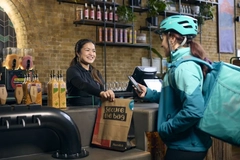 (Image Credit: Deliveroo).
Deliveroo has launched a PLA-lined paperboard takeaway box, designed by students from Sheffield Hallam University, UK, and produced by Biopak.
The paper-based solution is biodegradable and can be composted in food waste streams, where applicable. The box’s lining is made from a plant-based material, and the design features a new locking mechanism.
Jen Bagshaw, head of Packaging at Deliveroo, says: “We are constantly seeking innovative solutions to global challenges. Partnering with the talented apprentices at Sheffield Hallam University has been an inspiring journey, allowing us to champion the next generation of sustainable packaging designers.”
“By providing the platform and financial backing to turn the students’ creative vision into a reality, we are thrilled to see this solution officially launch on our webstore for our partners to purchase.”

The partnership between Deliveroo, Biopak, and Sheffield Hallam University, formed as part of Deliveroo’s first Sustainable Packaging Challenge in 2024, in which a student was challenged to design a takeaway box that prevented spillages and maintained food at the right temperature.
The competition was won by students Josephine Cooper and William Shaw, who designed a sealing system that uses additional folds in the cardboard to create a more secure locking mechanism.
Winners of the competition, Shaw and Cooper, add: “Seeing our design progress from a university project to a live product on the Deliveroo webstore is an incredible feeling. We focused on creating a locking mechanism that performs in the real world. We hope this proves that sustainable packaging can be highly functional and cost-effective.”
Compostable solutions
Deliveroo highlights that, as food-contaminated plastic is rarely recycled, compostable packaging offers an “alternative end-of-life route” to conventional plastic takeaway boxes.
Compostable solutions are increasing as innovation targets end-of-life solutions that promote circularity. Recently, Packaging Insights spoke to Tipa Compostable Packaging about the company’s compostable label to be presented at Packaging Innovations 2026 this week.
“Most conventional labels contaminate organic waste streams, creating significant challenges for composting operations,” says Gary Tee, vice president of Global Converting at Tipa Compostable Packaging.
“Tipa’s compostable labels directly address this gap by aligning packaging design with how waste systems actually function, and regulatory developments are increasingly pointing toward compostable labels as the preferred solution.”
Eco-Products launched its portfolio of reusable, recyclable, and compostable packaging in the UK. The solutions are set to be available through UK-based Vegware, a sister company.
Meanwhile, a United States Department of Agriculture board voted against adding synthetic compostable materials, such as those derived from biodegradable packaging, to the National List of Allowed and Prohibited Substances due to potential contamination with PFAS and microplastics.